
see all blog articles

Transforming Healthcare Bridging the Digital Divide

Author Image

Mitch Budreski

Principal | Full Stack Developer

Team Member

Healthcare demand is consistently high, and time is always in short order.

We know this firsthand from working closely with our clients and through our discovery processes with them.

We want to share some insights from the Acorn team's time at the International Economic Forum of the Americas (IEFA) Conference of Montreal - Leading In An Accelerating World. The IEFA brings together leaders from various sectors—government, business, unions, and academia—to spark innovation and tackle the world's biggest challenges.

During the panel on 'The Digitalization of Healthcare,' it became clear how much room there is to improve data management, user experience, and the integration of diverse data sources to help medical professionals overcome current and upcoming challenges.


A lot of the topics discussed at the conference of Montreal are services that Acorn can support. Take a look at our services and let us know how we can collaborate!

5 professionals sitting on chairs having a discussion on the IEFA stage with a screen behind them.
The moderator and panelists from the Digitalization of Healthcare discussion at the IEFA Conference of Montreal

Panelists (left to right) :

Vincent Oliva, President, Fédération des médecins spécialistes du Québec (Canada); Roberto R. Pupo, Partner, Holland & Knight LLP (United States); Justin Cross, Chief Digital Health Officer, CIUSSS West-Central Montreal (Canada & United States); Carole Jabet, Scientific Director, Fonds de recherche du Québec en santé (Canada)

2 entrepreneurs on an escalator dressed in business suits, looking professional and having fun.
Mitch and Sam entering the IEFA Conference of Montreal in June of 2024

Our participation in the Conference of Montreal reinforced that Acorn is uniquely positioned to provide valuable support in these areas and related fields in medical service delivery.

Acorn is currently working with wheelchair, mobility, and accessories providers on digital infrastructure and e-commerce projects. As we broaden our industry engagement, we can apply our expertise but are not limited to:

  • Mobility and Seating
  • Rehabilitation Technology Centers
  • Assistive Technology Clinics
  • Orthotics and Prosthetics Clinics

From both the conference and our time serving clients as a software development agency...

we're realizing there are trends that should be acknowledged in order to solve systems level problems.

Download an accessible PDF here.

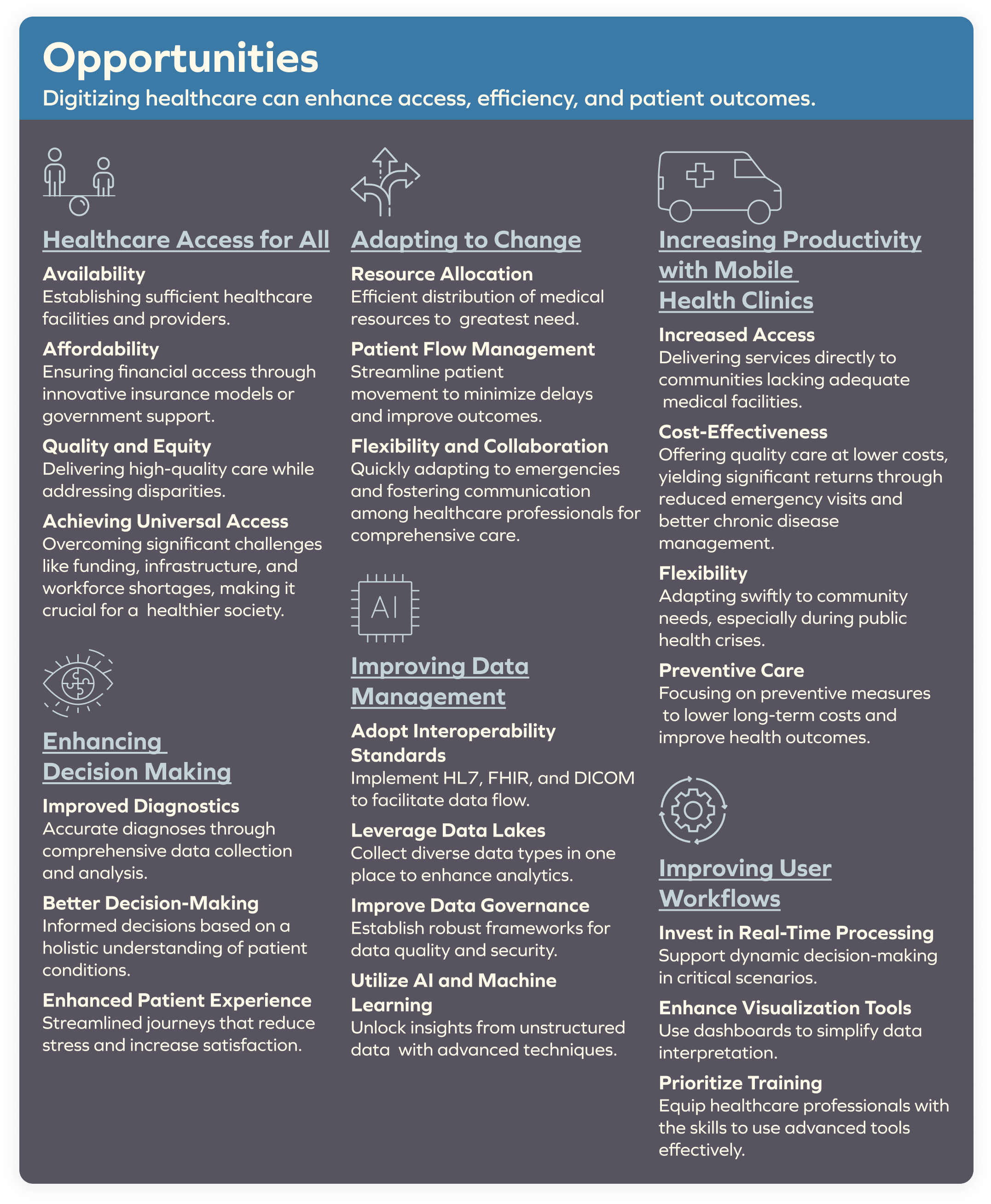
The image outlines the opportunities that come with digitizing healthcare to improve access, efficiency, and patient outcomes. It highlights key areas where digital transformation can make a significant impact:  Healthcare Access for All: Emphasizing availability, affordability, quality, and equity in healthcare by ensuring universal access and overcoming challenges such as workforce shortages and financial barriers. Adapting to Change: Efficient resource allocation, patient flow management, and fostering collaboration among healthcare professionals to improve care during emergencies and streamline operations. Increasing Productivity with Mobile Health Clinics: Delivering care directly to underserved communities, reducing costs, and improving outcomes through preventive care and swift response during public health crises. Enhancing Decision Making: Improving diagnostic accuracy and informed decision-making through data-driven insights, which in turn enhance patient experiences and reduce stress. Improving Data Management: Promoting the adoption of interoperability standards, leveraging data lakes, enhancing data governance, and utilizing AI and machine learning for deeper analysis. Improving User Workflows: Supporting real-time processing, enhancing visualization tools, and providing training for healthcare professionals to use advanced technologies effectively.
Opportunities
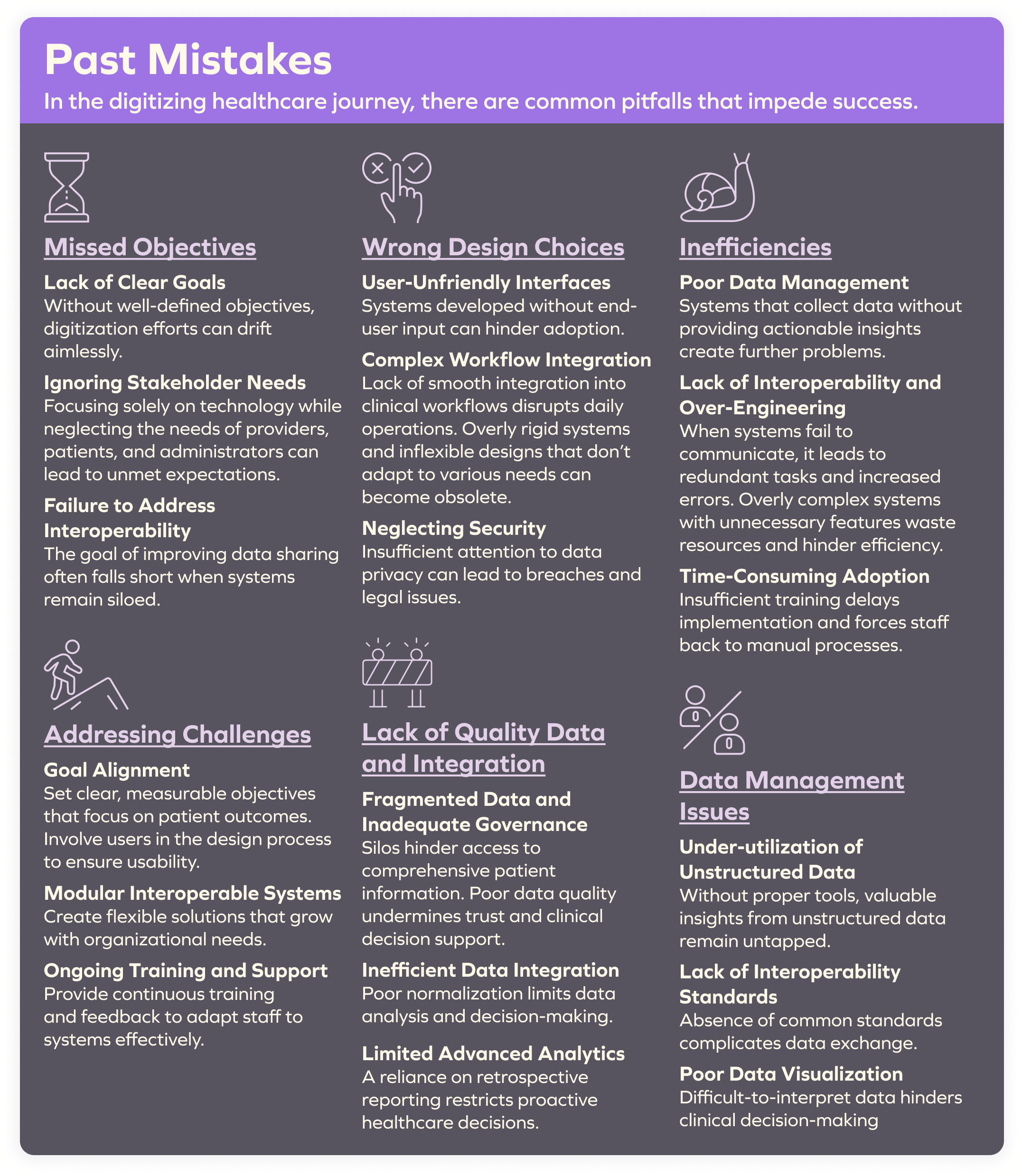
The image highlights common pitfalls in the digitization of healthcare, which can hinder success. It covers the key mistakes often encountered during this transition:  Missed Objectives: 	•	Lack of clear goals leading to unfocused digitization efforts. 	•	Ignoring stakeholder needs by not involving providers, patients, and administrators, which can result in unmet expectations. 	•	Failing to address interoperability, leaving systems siloed and unable to effectively share data. Wrong Design Choices: 	•	Developing user-unfriendly interfaces without considering end-user input, which can hinder adoption. 	•	Failing to integrate smoothly with clinical workflows, causing disruptions in daily operations. 	•	Neglecting security, which compromises data privacy and increases the risk of breaches and legal issues. Inefficiencies: 	•	Poor data management where collected data is not transformed into actionable insights, leading to further problems. 	•	Lack of interoperability and over-engineering, creating redundant tasks and inefficiencies. 	•	Slow adoption due to inadequate training, forcing organizations to revert to manual processes. Addressing Challenges: 	•	The need for goal alignment by setting measurable objectives focused on patient outcomes and involving users in the design process. 	•	Creating modular and interoperable systems that grow with organizational needs. 	•	Offering ongoing training and support to continuously adapt staff to new technologies. Lack of Quality Data and Integration: 	•	Fragmented data and inadequate governance that limit access to comprehensive patient information. 	•	Inefficient data integration and limited advanced analytics that prevent proactive healthcare decisions. Data Management Issues: 	•	Under-utilization of unstructured data, leaving valuable insights untapped. 	•	Lack of interoperability standards, complicating data exchange. 	•	Poor data visualization that makes it difficult to interpret data, hindering clinical decision-making. The overall theme of this image is to emphasize the importance of avoiding these mistakes to ensure successful healthcare digitization, leading to improved outcomes, better efficiency, and effective data use.
Past Mistakes
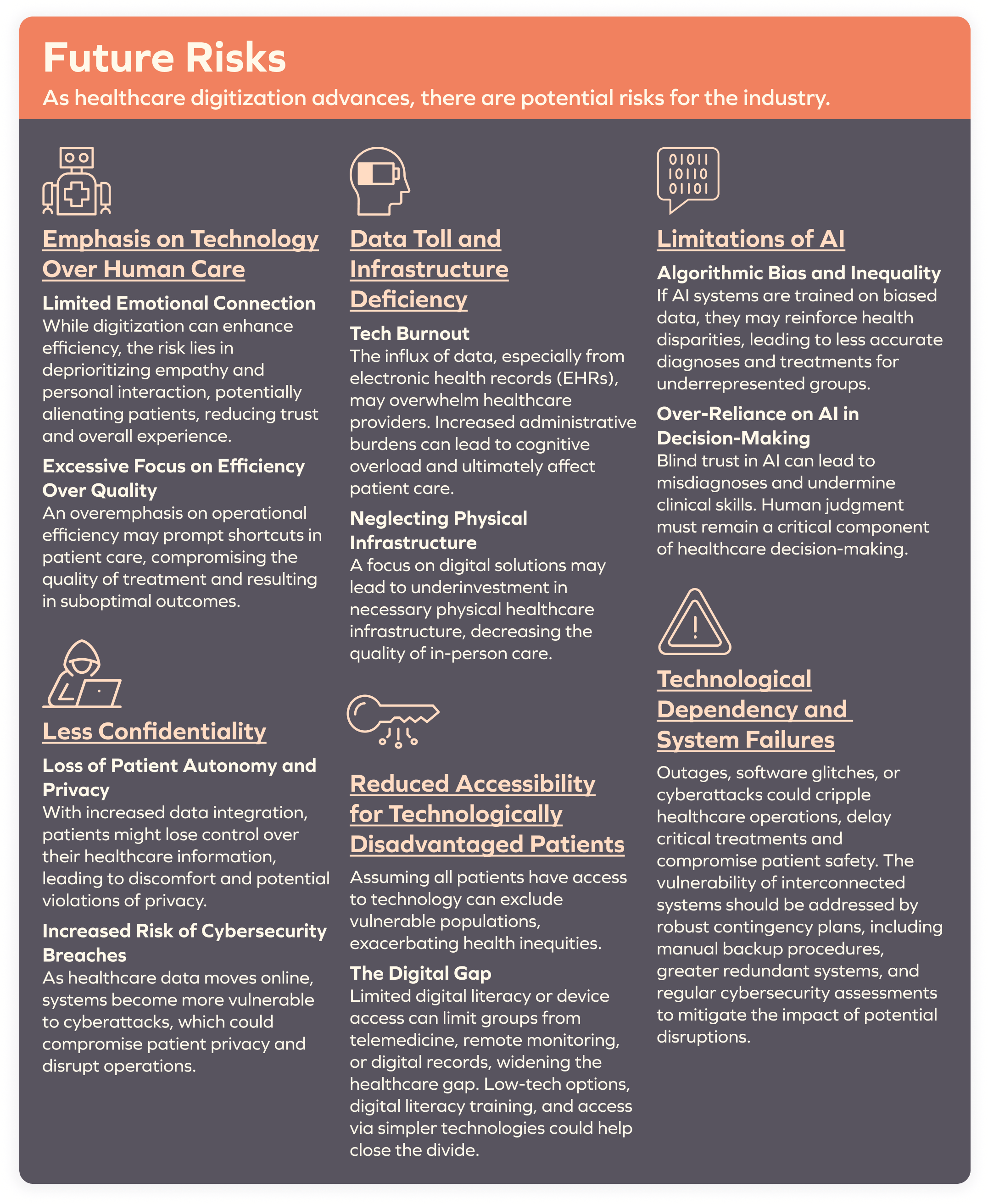
The image outlines potential risks associated with the advancement of healthcare digitization, identifying several critical areas of concern:  Emphasis on Technology Over Human Care: 	•	Limited Emotional Connection: The efficiency gained through digitization may come at the cost of empathy and personal interaction, reducing patient satisfaction and overall care experience. 	•	Excessive Focus on Efficiency Over Quality: Prioritizing operational efficiency can result in shortcuts in care, compromising treatment quality and leading to suboptimal health outcomes. Data Toll and Infrastructure Deficiency: 	•	Tech Burnout: The overwhelming influx of data, especially from electronic health records (EHRs), can cognitively overload healthcare providers, impacting patient care. 	•	Neglecting Physical Infrastructure: The focus on digital solutions might reduce investment in essential physical healthcare infrastructure, negatively affecting the quality of in-person care. Limitations of AI: 	•	Algorithmic Bias and Inequality: AI systems trained on biased data may exacerbate healthcare disparities, leading to less accurate diagnoses and treatments, particularly for underrepresented groups. 	•	Over-Reliance on AI in Decision-Making: Excessive dependence on AI can undermine clinical judgment and result in misdiagnoses, highlighting the importance of maintaining human oversight in healthcare decisions. Less Confidentiality: 	•	Loss of Patient Autonomy and Privacy: Patients may lose control over their healthcare information as data integration increases, leading to discomfort and potential privacy violations. 	•	Increased Risk of Cybersecurity Breaches: The digitization of healthcare data makes systems more vulnerable to cyberattacks, which could compromise patient privacy and disrupt operations. Reduced Accessibility for Technologically Disadvantaged Patients: 	•	The Digital Gap: Limited access to technology can exclude vulnerable populations from telemedicine, remote monitoring, and digital records, worsening health inequities. Offering low-tech solutions and digital literacy training could help bridge this gap. Technological Dependency and System Failures: 	•	System Vulnerabilities: Outages, software failures, or cyberattacks could severely disrupt healthcare operations, delay critical treatments, and compromise patient safety. Implementing robust contingency plans, backup procedures, and cybersecurity assessments is crucial to mitigate these risks. The overarching theme of this image emphasizes the importance of balancing technological advances with patient care, privacy, accessibility, and infrastructure to avoid the potential risks of healthcare digitization. 1:24
Future Risks
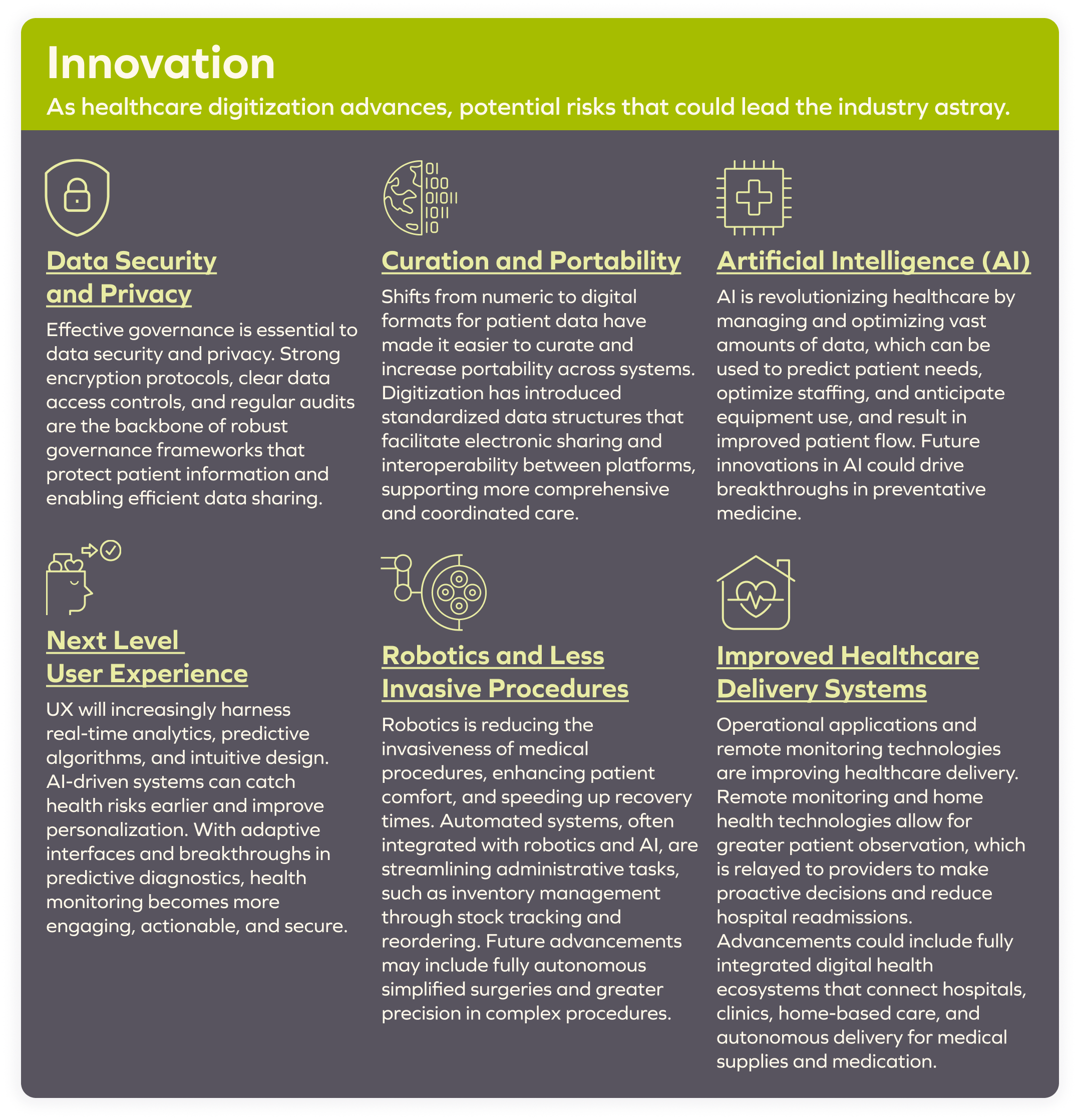
The image outlines key areas of innovation in healthcare digitization, emphasizing advancements that could enhance the industry but also present potential risks:  Data Security and Privacy: 	•	Effective governance is crucial for safeguarding data security and privacy. Strong encryption protocols, clear access controls, and regular audits are essential for protecting patient information and ensuring efficient data sharing within healthcare systems. Curation and Portability: 	•	Shifting from numeric to digital patient data formats improves data portability and accessibility. Standardized data structures facilitate electronic sharing and interoperability between platforms, enhancing coordinated care and supporting comprehensive healthcare delivery. Artificial Intelligence (AI): 	•	AI is transforming healthcare by optimizing data management, predicting patient needs, and improving workflow efficiency. AI-driven innovations have the potential to improve patient flow, optimize staffing, and enhance equipment usage. Future breakthroughs may include significant advancements in preventive medicine. Next Level User Experience: 	•	User experience (UX) in healthcare will leverage real-time analytics, predictive algorithms, and AI-driven systems to enhance personalization and early health risk detection. Adaptive interfaces will improve patient engagement, making health monitoring more interactive, secure, and actionable. Robotics and Less Invasive Procedures: 	•	Robotics is revolutionizing medical procedures by reducing invasiveness, improving patient comfort, and accelerating recovery times. Automated systems, often integrated with AI, are streamlining tasks like inventory management, and future innovations may lead to fully autonomous surgeries and greater precision in complex operations. Improved Healthcare Delivery Systems: 	•	Operational applications and remote monitoring technologies are advancing healthcare delivery. Remote patient monitoring and home health technologies allow for better observation and proactive care. Future innovations may involve integrated digital health ecosystems that connect hospitals, clinics, home-based care, and autonomous delivery of medical supplies and medications. The overall theme of this image highlights how innovative technologies such as AI, robotics, and digital data systems can transform healthcare delivery while emphasizing the importance of maintaining robust data security, user experience, and accessibility to ensure sustainable progress.
Innovation

Download an accessible PDF here

To summarize:

There's a lot to do... and a lot that can be done! The past few years have shown us more than ever that decision overload is real and data increasingly needs to be managed, secured and used effectively.

Acorn Interactive is committed to identifying the right problems to tackle with clients. Our expertise includes:

  • producing meaningful digital architectures that provide analytics/diagnostics
  • user experience paradigms
  • user interface patterns
  • holistic digital system designs

These skills are congruent to resolving many of the issues outlined in the Digitization of Health session at the Conference of Montreal. Our hope is to better serve medical equipment vendors, medical practitioners, and medical administrative teams with immersive digital experiences.

It all starts with a conversation. Getting to know one another. Learning how we can help our clients.

We can't wait to get started.

If you'd like to continue brainstorming with us, please fill out the form below.


Author Image

Mitch Budreski

Principal | Full Stack Developer